
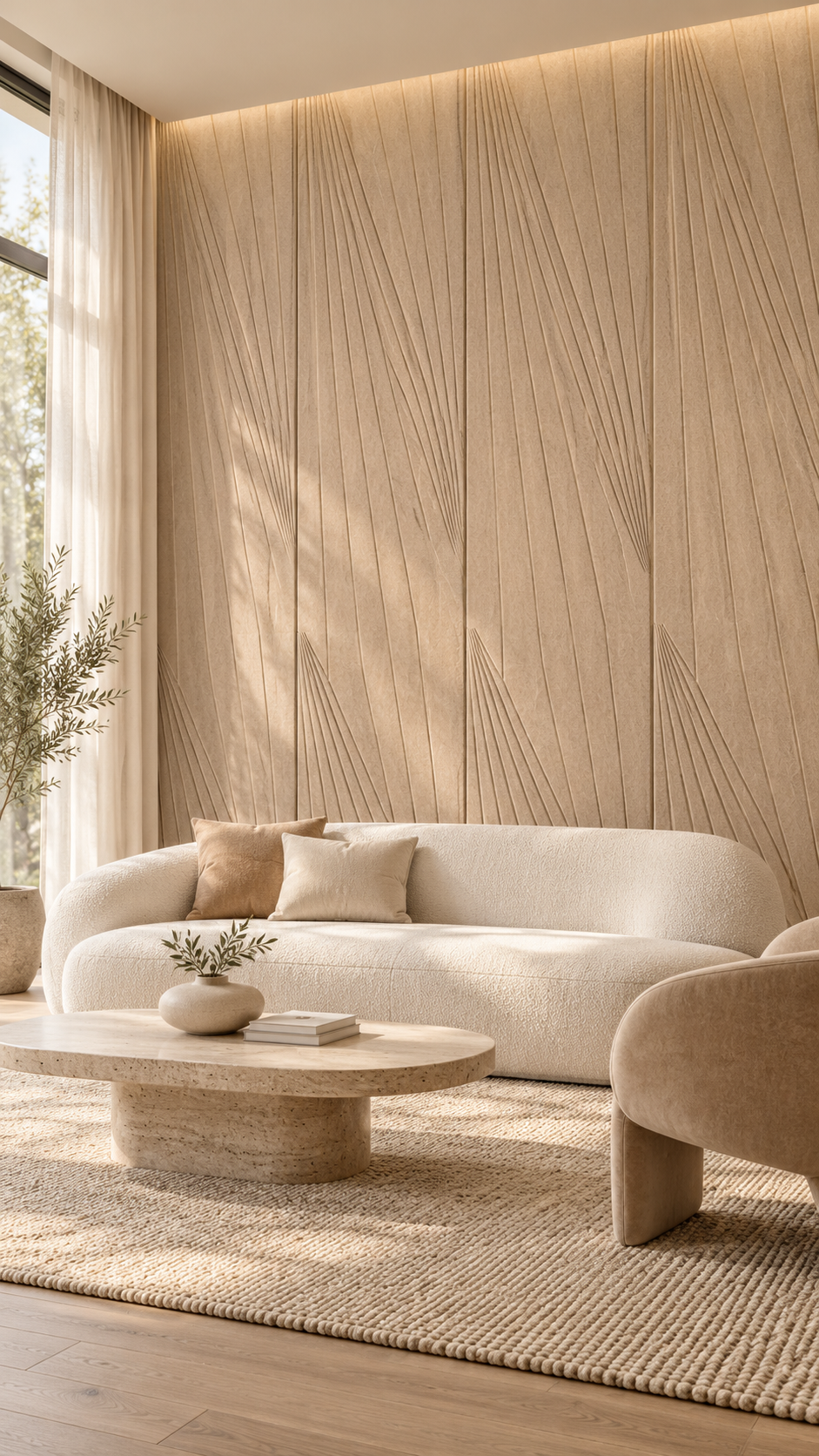
The Short Answer
There is no single panel count that fits every room. Acoustic treatment depends on room volume, surface hardness, and how the space is used. Target coverage ranges from roughly 10% of total wall area for living rooms to 25–35% for media spaces. Always calculate your required square metres (m²) first before selecting individual panels.
Why “How Many Panels?” Is the Wrong Question
Most online acoustic calculators ask for room dimensions in imperial feet and output an arbitrary panel count without explaining the underlying acoustics. Focusing on panel count rather than surface area leads to two frequent mistakes: under-treating the room—mounting two decorative panels and wondering why video calls still echo—or over-treating the room, cladding every surface until speech loses natural brightness and feels acoustically “dead”.
To achieve balanced acoustics, think in square metres (m²), not panel counts. Once you know the total square metres of sound absorption required, you can mix standard felt sheets (2400 × 1200 mm, approximately 2.9 m²), acoustic art pieces (0.64 m² to 1.44 m²), and ceiling baffles to seamlessly hit your target.
Rule of Thumb by Room Type
Dubai spaces frequently feature polished marble floors, extensive glazing, and bare gypsum. Because hard surfaces reflect over 95% of sound, these rooms typically require coverage toward the upper end of standard ranges.
Open Living Rooms & Majlis
Common challenge: Ringing cutlery, high ceilings, and harsh chatter.
Target coverage: 10–15%.
Typical treatment: Wall panels, acoustic art, and thick rugs.
Home Offices
Common challenge: Slap-echo on Zoom and hollow microphone pick-up.
Target coverage: 15–20%.
Typical treatment: A feature wall behind the desk.
Glass Meeting Rooms
Common challenge: Distorted voice calls and speech build-up.
Target coverage: 20–30%.
Typical treatment: Panels combined with ceiling baffles.
Home Cinemas
Common challenge: Dialogue muddiness and flutter echo.
Target coverage: 25–35%.
Typical treatment: Wall arrays and ceiling rafts.
Cafés & Restaurants
Common challenge: Guests shouting to be heard, known as the Lombard effect.
Target coverage: 25–35%.
Typical treatment: Hanging dividers and wall runs.
The Metric Method in 5 Steps
While commercial boardrooms follow strict acoustic engineering guidelines, homes have no mandatory targets. For an exact, engineered calculation, follow these five steps.
Step 1: Measure Room Volume
Calculate the total volume of your room in cubic metres.
V = Length × Width × Height
Measure all dimensions in metres to obtain volume in m³.
Step 2: Choose Target Reverberation Time (RT60)
RT60 is the time in seconds sound takes to decay by 60 dB.
Target approximately 0.6 seconds for meeting rooms and approximately 0.7–0.8 seconds for residential living areas.
Step 3: Calculate Required Absorption
Use the Sabine formula to find total metric absorption units:
A_target = (0.161 × V) ÷ RT60
Step 4: Subtract Existing Furnishings
Soft sofas, wool rugs, and heavy curtains already absorb sound. Deduct their estimated absorption from your target:
A_needed = A_target − A_existing
Step 5: Divide by the Material’s Rating
Divide A_needed by your panel’s absorption coefficient.
In the examples below, a sample benchmark rating of 0.5 is used to illustrate the maths.
Worked Dubai Examples
Example A: Glass Meeting Room
Room size: 5 m × 4 m × 3 m.
Room volume: 60 m³.
Target RT60: 0.6 seconds.
Target absorption: (0.161 × 60) ÷ 0.6 = 16.1 units.
Existing absorption: Glass and chairs ≈ 6.5 units.
Additional absorption needed: 16.1 − 6.5 = 9.6 units.
Area required at a 0.5 rating: Approximately 19.2 m².
Layout: Approximately seven full felt sheets measuring 2400 × 1200 mm, or four wall sheets plus a ceiling baffle array.
Example B: Villa Majlis
Room size: 8 m × 6 m × 6 m.
Room volume: 288 m³.
Target RT60: 0.8 seconds.
Target absorption: (0.161 × 288) ÷ 0.8 = 57.9 units.
Existing absorption: Rugs and drapes ≈ 22 units.
Additional absorption needed: 57.9 − 22 = 35.9 units.
Area required at a 0.5 rating: Approximately 72 m².
Layout: Combine a grooved feature wall, acoustic art pieces at eye level, and suspended ceiling rafts.
Strategic Placement & Avoiding Over-Damping
Where you position acoustic panels matters just as much as how many square metres you install. Following a few key principles ensures your investment performs optimally.
Position at Speech Level
Mount wall panels between 1.2 m and 2.0 m above the floor where seated and standing voice frequencies directly reflect.
Break Up Parallel Walls
Leaving opposing hard walls bare creates rapid flutter echo. Treating at least one wall of an opposing pair calms the room significantly.
Use the Ceiling
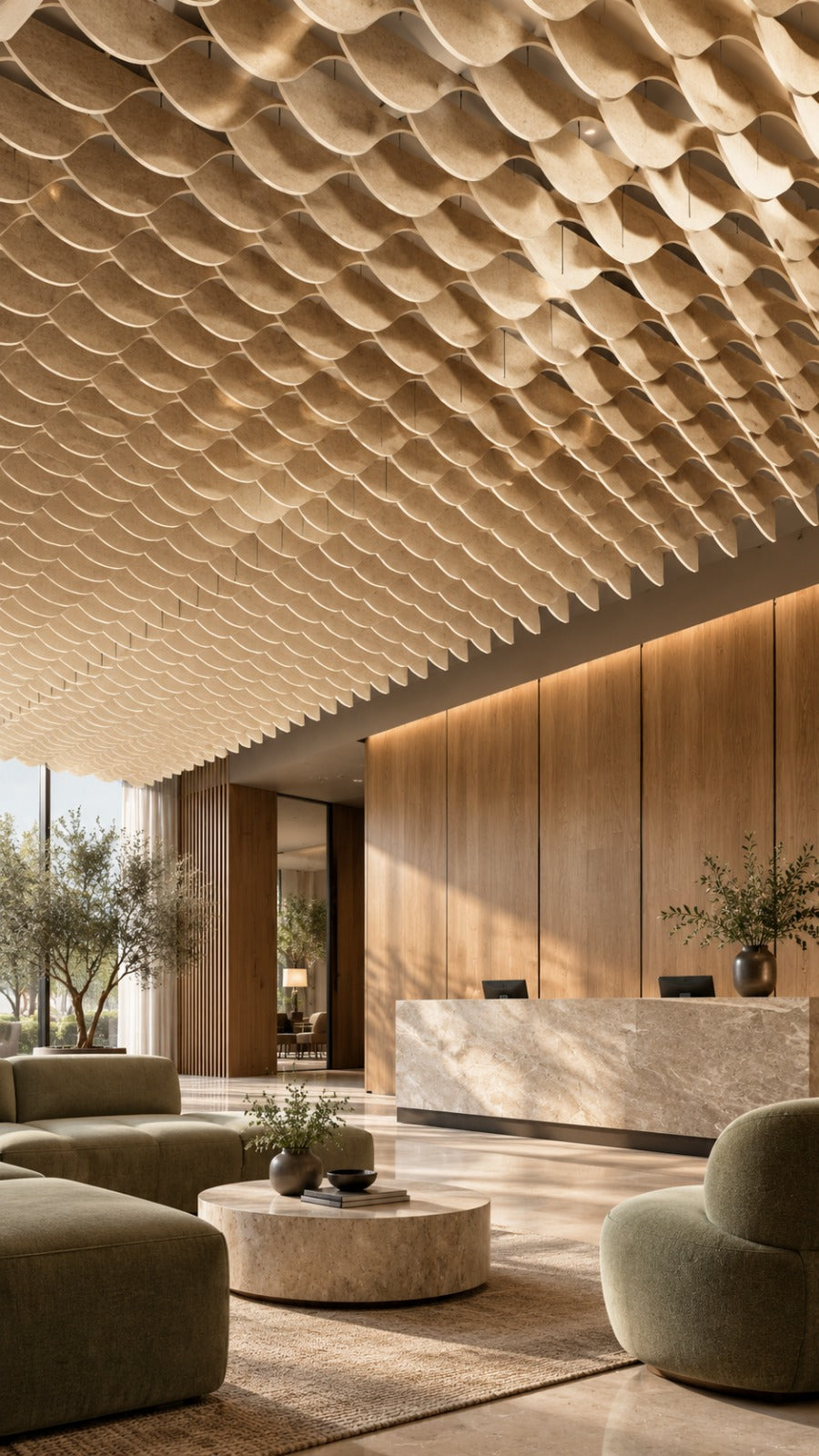
In rooms with stone floors and floor-to-ceiling windows, overhead suspended baffles deliver massive absorption without consuming usable wall space.
Avoid Deadening the Space
Exceeding 40–50% wall coverage often removes natural acoustic warmth, making everyday speech feel strained and unnatural.
Frequently Asked Questions
Can one or two panels fix an echoey living room?
A single panel covers less than 1 m², which is too small to make a noticeable dent in a standard room’s echo. Meaningful improvement requires treating at least 10% of total wall area.
Is ceiling treatment better than wall panels?
Both work effectively, but ceiling baffles are ideal when walls are occupied by glass, artwork, or cabinetry. Because baffles hang freely, both sides of the felt absorb sound waves.
Do sofas and curtains count toward acoustic treatment?
Yes. Thick upholstery, wool rugs, and dense drapes absorb higher audio frequencies and should be subtracted from your room’s total absorption deficit.
Will adding enough panels soundproof my room?
No. Acoustic panels only reduce reflection and echo within a room. Blocking noise through shared walls or ceilings requires structural construction and physical mass.
What are the standard dimensions of Formed products?
Formed architectural felt sheets measure 2400 × 1200 mm. Acoustic art is available in multiple modular formats, including 0.64 m² and 1.44 m², and ceiling baffles in 120 × 240 cm units.
Can I mix plain felt panels with acoustic art?
Yes. Because all pieces use compatible acoustic felt materials, plain sheets, 3D grooved panels, and sculpted art can be combined into a single cohesive installation.


Leave a comment
All comments are moderated before being published.
This site is protected by hCaptcha and the hCaptcha Privacy Policy and Terms of Service apply.